

Author: Hansika Singh
March 25, 2026
Beauty of Imperfections
Before the world fills with noise, somewhere a pair of tired hands has already begun its work.
Fingers move slowly over clay, threads, wood, or fabric, shaping something that did not exist
yesterday. There is no rush in this quiet corner. Only patience and care.
Every curve is formed by touch. Every detail carries a moment of effort. Sometimes the line
is not perfectly straight, sometimes the pattern shifts slightly but in those tiny imperfections
lives something machines will never understand. In those tiny curves lives the love and hope
of the dreamer behind the art.
Handmade creations are not just products. They are pieces of someone’s time, someone’s
struggle, someone’s hope.
And yet, when these creations finally reach us, we often look at them with the same
expectations we place on machines, expecting flawless perfection, forgetting that the beauty
of handmade work was never meant to be perfect. It was meant to be human.
It is selfish to only want things to always work better for us, for things to last forever without
even the slightest scratch. And when things don’t last forever we often blame the person who
created it.
What we don’t give importance to is the fact that nothing could ever last forever, not
something made with clay, not something made with threads and not something made with
just words.
But what does last forever are the feelings and emotions behind the object, what stays are the
thoughts that the person while making it would’ve been thinking, even when it’s in broken
pieces.
For the artisan, creation is personal. Each product carries a part of their story a quiet record of
the hours spent bending over their work, the mistakes corrected, the adjustments made by
instinct rather than instruction manuals. The artisan knows every curve, every thread, every
small irregularity.
For the factory worker, the process unfolds quite differently. The work is repetitive, dictated
by machines engineered for speed and efficiency. The objective is uniformity, every piece
must mirror the one before it with mechanical precision.
But when such an object finally reaches us, what truly makes it special?
I like to believe that even the smallest objects find their way to us for a reason. There may be
thousands of identical pieces, produced in endless succession, yet somehow the one that
ultimately reaches your hands feels as though it was always meant to find you.
Instead of celebrating our fate of finding such beautiful imperfections made just for us, we
expect handmade products to be flawless. Perfect lines. Perfect shapes. Perfect finishing.
In other words, we expect them to look just like the ones produced by machines.
But handmade creations were never meant to imitate machines.
A slightly uneven stitch. A curve that bends a little more than expected. A pattern that shifts
ever so slightly. These are often labeled as “imperfections.”
Yet these small irregularities are not flaws. They are evidence.
Evidence that the piece was shaped by human hands instead of mechanical arms.
Machines create perfection because they are programmed to repeat the same movement
endlessly without fatigue, emotion, or hesitation. But human hands are different. They carry
tiredness. They carry experience. They carry individuality.
And sometimes, what their hands carry is hope. A quiet, unwavering hope that breathes life
into their craft. It reveals itself in every stroke, every curve, every carefully shaped detail,
making their creations even more beautiful than the eye can immediately see. It is this hope
that fuels their passion, inspiring them to keep creating, to keep shaping something new for
the world to admire.
Yet, far too often, these artisans are never given the opportunity to let their work reach the
stage it deserves. Their creations remain unseen, their talent quietly confined to small
workshops and forgotten corners.
Even as I write this, somewhere in the world a unique piece of art may be resting on a dusty
windowsill, waiting patiently to be discovered. Beneath that thin layer of dust lies not just a
creation, but a dream, the dream of the artisan who crafted it with tired hands and hopeful
eyes.
Are we expecting too much from handmade
For that artisan, the piece was never just art.
It was hope for a living, hope for dignity, hope for a better tomorrow. For himself. For his
family.
Many artisans work with limited resources. Their tools may be simple. Their materials
carefully saved. Their workspace modest. But what they bring to their craft is something
machines cannot replicate: patience, creativity, and the quiet determination to turn skill into
survival.
When an artisan spends hours creating something, they are not just producing an object. They
are investing effort, attention, and often a part of their identity into the work. The small
irregularities left behind are not mistakes; they are traces of that journey.
Each handmade piece becomes slightly unique, like a fingerprint.
Yet in a world shaped by mass production, we have slowly trained our eyes to value
uniformity over individuality. We hold a handmade object and immediately search for what is
“wrong” with it instead of asking what makes it special.
But perhaps we are looking at it the wrong way.
Machines can create objects that are identical, flawless, and endlessly reproducible. They can
produce thousands of copies in the time it takes an artisan to finish one.
But what machines cannot create is meaning.
A handmade product carries a story within it, the quiet concentration of its maker, the slow
rhythm of creation, the persistence behind every finished piece. Sometime it’s the
conversations the maker has while creating something.
The next time you hold something handmade, pause for a moment before judging its
imperfections.
Look a little closer.
The uneven edge might be the mark of hours spent perfecting a technique. The tiny irregular
pattern might be the result of hands that refused to give up despite exhaustion. A tiny smudge
might have been the result of an unwanted argument with the loved ones.
And in that moment, you may realize something important.
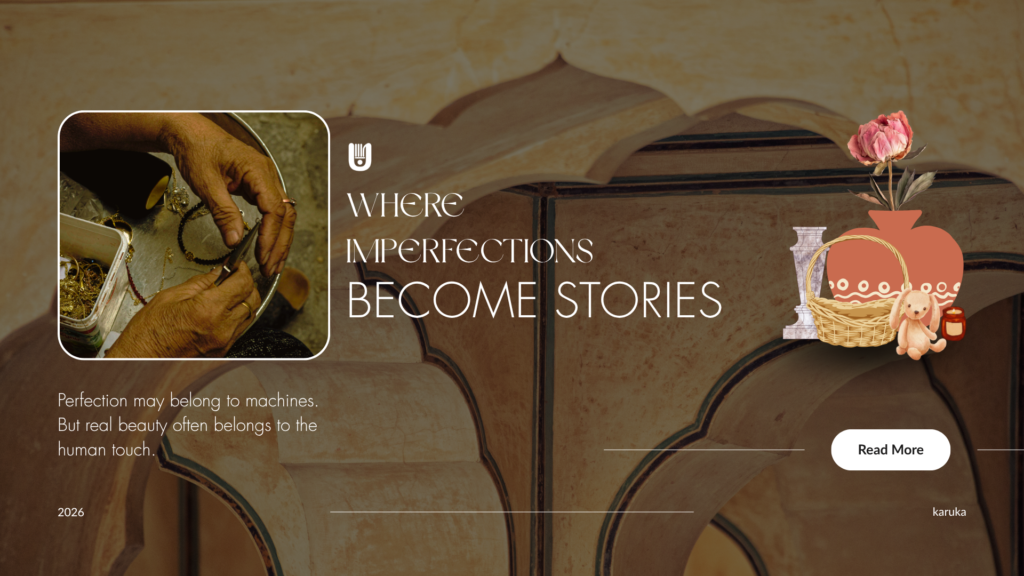
Perfection may belong to machines.
But beauty? Real beauty often belongs to the human touch.