

Calling the global creators to “Step Out and Innovate” this International Creativity and Innovation Day.
Author – Srushti Sonawane
“I am an artisan; I create. I go down to the realms of imagination and beyond. I stand at the precipice of the worth of my art in my eyes and the eyes of the world, and there… there both the worlds collide.”
This is not a lament—it’s a quiet revolution. Who carves, who weaves, who paints not just on canvas, but on the soul of culture itself. Where does the artisan of the day stand amidst the hurricane of overwhelming technological advancements? In the sudden deracination of authenticity of art in the face of these advancements storming every new day, the crafting hands of the artisans might feel a slight shiver.
And yet, in 2025, artisans like these are forced to stand against a gusting windstorm of artificial intelligence, facing what can only be called an algorithmic avalanche that threatens to bury the essence of human-made creation beneath digital mimicry – through our every autocorrected word to every ad pop-up that one can’t help but relate to. The voyeuristic eye of such advancements has now hit our doors with more intensity than ever. We are petrified with the enormity of how the once revered art forms are now accessible to anyone who is far away from acknowledging the existence of such reverence.
Amidst this brewing storm of generative AI, “Stepping Out and Innovating” may sound rather daunting and encourage a meek submission to the technological churn. That gives creators all the more reason on this International Creativity and Innovation Day to “Step Out and Innovate”, not simply to take up artistic liberties of creation but to probe what it is that we truly embrace in the name of art.
Standing on the hypocentre of this digitally homogenised culture, where one keystroke can summon an entire aesthetic universe, where does the artisan of the day stand?
The Ghibli Controversy: A Case of Stolen Whimsy
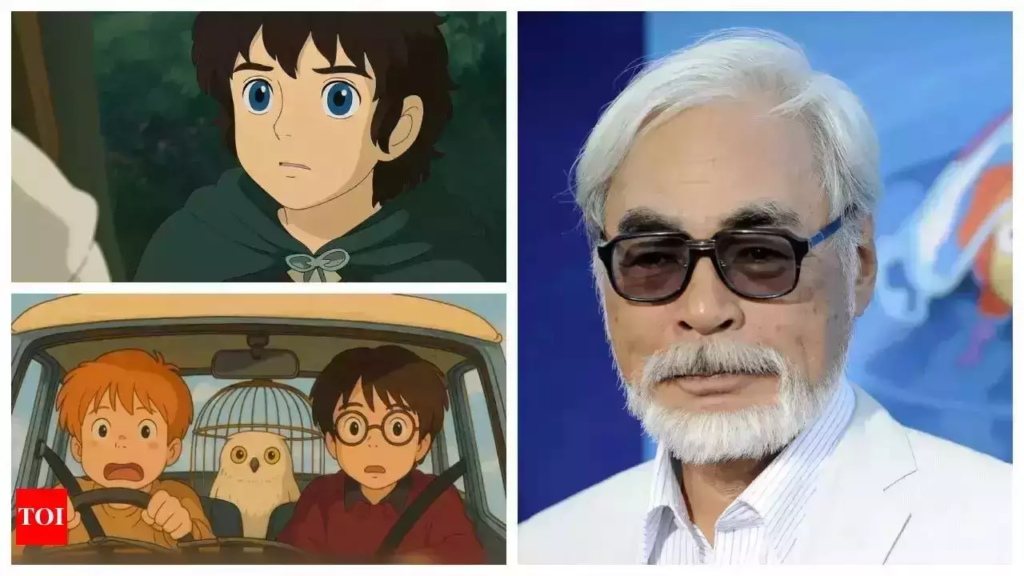
To understand the gravity of this shift, we must first tread gently into the world of Studio Ghibli. Hayao Miyazaki, the pioneer of Studio Ghibli, an animated film art form, had introduced his art in the remembrance of his memories of his personal experiences, the Japanese folklore and even his environmentalist ventures. The studio’s name, “Ghibli”, was chosen by Miyazaki in honour of the Italian scouting plane named “Ghibli”, reflecting his love for flights and innovation. The verdant stillness of My Neighbour Totoro, the haunting beauty of Spirited Away, and the melancholy skies of The Wind Rises are fragments of a living philosophy. A blend of subtle colour combinations, easy on the eye and easier on the soul, paired with compositions resembling the comfort of white noise, makes it all a perfect amalgamation of art and innovation.
And yet, recent AI replications of Ghibli-style art—generated without understanding, without soul—have flooded digital spaces. What is truly endangered here is not just an art style but the very soul of intentional creation. The AI may replicate brushstrokes, but it cannot remember like Miyazaki. It may generate compositions, but it cannot grieve, rejoice, or reminisce. And yet, these lifeless replications are finding equal footing in an art market that increasingly rewards speed over spirit.
For those in the know, this wasn’t flattery; it was a behemoth infiltration. It was, in the words of Miyazaki himself, “an insult to life itself.”
The Ethical Minefield: Originality, Ownership, and Obsolescence
Across India’s small towns, where generations of artisans toil to produce intricate crafts, each a fragment of lived heritage, the AI wave is less of a tool and more of a tidal displacement. The concern isn’t that AI exists; it’s that its exponential infiltration into the arts is often unaccompanied by ethical moorings. Consider:
- Devaluation of Artistic Skill: The truth is, AI doesn’t create; it predicts. It doesn’t feel; it learns patterns. And in this mechanised mimicry, the artisan is edged out from the frame, pixel by pixel. When AI-generated visuals compete on the same plane as human-created works, the intrinsic value of years of training and experience begins to erode.
- Erosion of Authenticity: Can an artwork devoid of emotion ever be considered truly original? Can the aesthetic of struggle, inherited grief, or ancestral lore ever be captured by an emotionless code? In a world run by clicks, likes, and quick consumption, they face what I often call the artisan’s paradox: to remain authentic, yet visible. To create with soul, yet survive the doom scroll.
- Homogenisation of Art: As AI learns from what is already created, it essentially learns to repeat. These creators, unlike their AI counterparts, cannot optimise algorithms. Their work cannot be “trained” into mass production. Creativity, then, risks being reduced to a repetition of mediocrity, masquerading as innovation.
- Job Displacement: From woodcarvers of Saharanpur to Pattachitra painters of Odisha, the artisan’s plight today is not about lacking creativity but lacking visibility in a digitally accelerated marketplace. As AI becomes “good enough”, many artists, illustrators, and designers are facing an existential question: Where is my place in this new ecosystem?
Reclaiming the Horizon: Crafting a Symbiosis
To carve a future where creativity is not colonised by computation, we must reframe our approach:
- AI as a Tool, Not a Tyrant: Remember how the seeds of each fanatical oppression of the greatest wars the world has witnessed have stemmed from the tyrannical motives of the ones drunk on power? In the present day, AI can be cautioned to be the uprising of such despotism. What we, as creative collaborators, can thus practice is to let AI aid our creativity with background automation while preserving the artist’s voice at the core.
- Ethical Frameworks: Drowning in the legalities of the ownership of intellectual properties has been a dangling sword over all creative pursuits which have dared to embrace a vision. We must thus enact transparent policies around AI-generated content, particularly regarding ownership and artistic credit.
- Focus on the Human Element: Even before placing an online purchase, we as consumers will rush to check the authenticity of the desired products. We imagine the textures, colours, and patterns based on the functionality of the product, which we can then use to enhance our lifestyle statement, even if it is not essentially “perfect”. In the quest to stand out, we go for a story that narrates us. Ergo, in a sea of pixel-perfect designs, it is the human imperfection that breathes life into art, thus narrating a story that defines us!
- Invest in Craftsmanship: The commonly lauded and graciously accepted humble apparel, Gamcha, has now been commercialised into a brand identity by the ones who could imagine its potential. One can thus further imagine the potential of the humble yet distinctive traditional art forms if we start seeing the same, not limiting to apparel but welcoming them in the pergola of everyday luxury. The way for the same is paved through determined upskilling, beholding the vision and the commerce. Governments and platforms must thus invest in upskilling and visibility for traditional artisans so that they aren’t overshadowed by artificial aesthetics.
Karuka: A Sanctuary of Authenticity in Digital Clamour
Karuka emerges as a platform which offers more than e-commerce and builds into resonance. Karuka reveres the artisan not as a supplier but as a storyteller, a preserver of intangible heritage. With International Creativity and Innovation Day’s 2025 theme – “Step Out and Innovate” – Karuka embodies innovation not as disruption but as restoration. Not the digitisation of art, but the dignification of the artist.
UNESCO’s 2022 report, Re-Shaping Policies for Creativity, reveals a startling insight: while the creative economy contributes 3.1% to global GDP and 6.2% to employment, it remains chronically underfunded and overlooked. Cultural exports reached $389.1 billion in 2019, yet artisans in developing nations still battle obscurity.
In this context, investing in platforms like Karuka becomes an act of global preservation. It is a stand against erasure. In the face of AI-generated designs that feel more like simulations than sensations, Karuka fosters what cannot be automated: the slow art of self-curation. A way of stepping out and innovating by reviving over replacing.
Between the Hammer and the Algorithm
As we honour International Creativity and Innovation Day, let us remember that true innovation converses with tradition without cannibalising it. We must put in more effort to not let speed equate with superiority or novelty with necessity.
To the artisan who stands today at the cliff edge of irrelevance, know this: your hands, your imagination, and your inherited memory are the resistance and not some dusty relics. They are what ground innovation in meaning. And as the digital hurricane howls louder, platforms like Karuka present themselves as the preachers of authenticity and practitioners of innovation.
Because somewhere between the hammer and the algorithm, there is still a place for soul!
